





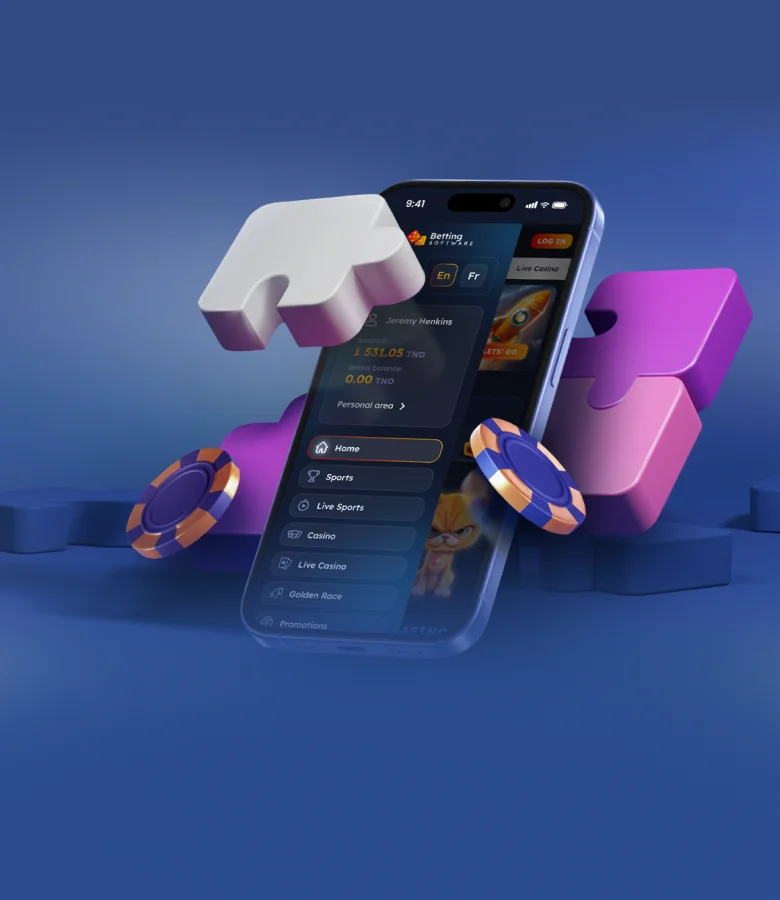
Build Your Own Online Casino App
Creating your own casino app means turning a licensed casino platform into something players actually download and keep on their phone – not just a mobile-friendly website squeezed into an app wrapper. It's a different build from a browser-based online casino, with its own technology choices, its own timeline, and its own cost.
Multi-language live support
Average time from sign to deploy
10,000+ games
100+ payment systems

What Building Your Own Casino App Actually Involves
A real casino app bundles the same core pieces as a desktop casino platform – licensed casino game development, a payment stack, compliance tools – into a package built specifically for a phone screen: touch-first navigation, push notifications, biometric login, and offline-friendly asset loading so a slot doesn’t stutter on a weak connection. None of that is optional for a serious online casino app. It’s the difference between an app players open once and one they open every day.
Native Mobile App, Progressive Web App, or Just a Fast Mobile Site?
There are three real options, and they aren’t interchangeable:
| Native App (iOS/Android) | Progressive Web App | Mobile Web | |
|---|---|---|---|
| App store presence | Yes, listed and downloadable | No – installed from the browser | No |
| Performance | Fastest, full device access | Close to native, some limits | Depends on connection |
| Best for | Brands investing in long-term player retention | Markets where app stores restrict real-money gambling apps | A fast first launch before a dedicated app |
| Typical timeline | Longer, more testing per platform | Faster than native | Fastest – no separate build |
Most operators start with a strong mobile site or a PWA, then build a native app once the brand has enough players to justify app store review, updates, and dual iOS/Android maintenance.

The Casino Game Development Process, Step by Step
- Define the game type mix – slots, roulette and other table games, live dealer, poker – for the target market, since that decision shapes everything else in the build.
- Choose a casino game development company or in-house team to handle the front-end, game logic, and the integration work that connects it to a licensed backend.
- Integrate the game providers, payment methods, and compliance tools into the app shell, rather than treating them as add-ons bolted on after launch.
- Test across devices, connection speeds, and both app stores’ review guidelines – a build that passes on a flagship phone can still fail on a mid-range Android device with a weak connection.
- Launch, then keep shipping updates – new slots, new promotions, performance fixes – since an app store listing that goes quiet loses ranking as fast as it loses players.
The Technology Behind a Modern Casino App
Under the hood, a casino app leans on a handful of technology choices that matter more than they look: a cross-platform framework to share code between iOS and Android without duplicating the whole build, a real-time layer for live dealer streaming and in-play odds, and a caching strategy that keeps a slot’s assets loading fast even on a patchy connection. None of that is visible to a player scrolling the lobby, but it’s the difference between a smooth session and one that drops mid-spin. The same technology stack needs to integrate cleanly with the payment rails and game providers already running on the platform side, rather than duplicating that logic inside the app itself.
iOS and Android: One App or Two?
Technically, it’s two separate builds sharing one back end – an iOS app under Apple’s review rules and an Android app under Google’s, each with its own store listing, its own update cadence, and in some regions, different restrictions on real-money gambling apps entirely. Cross-platform frameworks can share a lot of the underlying code, but the compliance layer – age verification, responsible gambling prompts, regional payment methods – still has to be built and tested per platform.
Why "App Maker" Templates Don't Work Here
A generic app maker or template can produce something that looks like a casino app in an afternoon. It can’t produce a licensed one. Real-money gambling apps need age verification, jurisdiction-aware payment routing, and a gambling license behind them – none of which a drag-and-drop app builder handles. Treat template tools as fine for a demo or a pitch mockup, not for anything that will actually process a deposit.

How Much Does It Cost to Build a Casino App?
A mobile front end running on top of BSW’s platform can be configured and live within days once branding and game selection are confirmed – the app shell reuses the same licensed backend, game providers, and payment integrations as the web platform, so most of the underlying cost is already solved. A fully custom native app with unique UI, bespoke game logic, or deep third-party API integrations is a separate project that runs on its own build schedule, quoted independently rather than bundled as a package.
Keeping Players Engaged After They Download
Getting the download is the easy part. An app earns its place on a player’s home screen through loyalty programs, well-timed promotions, and personalized game recommendations that reflect what someone actually plays rather than a generic push notification blast. Younger, mobile-native players expect all of that to feel immediate – a slow-loading slot or a clunky cashier screen gets uninstalled fast, not tolerated.
“Younger players are rewriting the rules of engagement.”
— Emily Thompson, iGaming Analyst at CasinoRank
That shift shows up directly in app design: shorter onboarding, instant feedback on every spin, and a user experience that respects how little patience a mobile session has for friction.

What a Finished App Looks Like
Rather than naming specific brands, it’s easier to describe the shape of a finished build: a home screen organized around a handful of featured slots and a live dealer lobby, a cashier screen that supports the market’s preferred payment methods, and a promotions tab that updates without an app store resubmission. BSW’s portfolio of past builds reflects that same pattern across different markets and brands, adapted rather than templated for each one.
FAQ
Do I need a casino game development company, or can I use an app maker?
A generic app maker can produce a demo, not a licensed real-money gambling app. Age verification, payment compliance, and jurisdiction rules need a casino game development company or an experienced in-house team behind them.
How much does it cost to build a casino app?
Configuring a mobile app on top of an existing, licensed platform is a fraction of building one from scratch – a custom native build with unique game logic runs considerably higher, priced on its own scope.
Do I need separate apps for iOS and Android?
Yes, functionally – they share a back end but go through separate app store reviews, and each platform has its own compliance quirks for real-money gambling apps.
What game types should launch first?
Slots typically carry the widest audience, with table games, live dealer, and poker filling out the library as the app matures. The right mix depends on the target market more than any general rule.
Can I add a sportsbook to the same app later?
Yes – a sportsbook module runs on the same core platform as the casino app, so it’s a later add-on rather than a separate build.



Talk Through
Your App Build
Native, progressive web app, or a fast mobile site first – the right starting point depends on the market, the game mix, and how the brand plans to grow. Get on a quick call to map out which one actually fits.