






How to Replace a Failing Sportsbook or Casino API Without Replacing the Whole Platform
faster game launch
game launch errors
transaction mismatches
support tickets

Where a partial migration fits
Replacing a sportsbook or casino API without a full migration means swapping only the failing module and leaving the platform and the wallet, with all player balances, untouched.
An operator in LatAm lost its sportsbook three times in one quarter, each time during a top match. The team priced the outages first, then replaced only the sportsbook and left the casino alone.
Segment and GEO: an established online casino and sportsbook operator in LatAm. Monthly GGR is $150,000, and $90,000 of it comes from the sportsbook.
Big Job: replace the module that keeps failing, whether it is the sportsbook or the casino API, and keep everything that works – the platform, the wallet, the players and their balances. The result is needed within months, not after a year of full migration.

The problem: outages hit when the money is made
The operator loses its sportsbook exactly when it earns the most. Within one quarter there were three P1 incidents of 30–60 minutes each, all on weekends during top matches. The provider named a different cause every time and offered no fix plan. The casino on the same platform worked without failures.
Client’s words: “We wait for every big match not with excitement but with fear that the line will go down again. We want to understand what these outages really cost us and whether we can leave them behind without risking the whole business.”

Two common reactions, and why both fail
In this situation operators usually pick one of two extremes.
“Let’s wait until the provider fixes it.” A 40-minute outage means $500 of directly lost GGR, so a failure feels unpleasant but cheap. That estimate counts the downtime itself and ignores what happens after it.
“The platform keeps failing, so we move everything.” Full migration looks like a radical answer. But the stable casino goes into the move together with the failing sportsbook, and with it balances, game sessions, bonuses and payments. One module’s problem becomes a risk for the entire GGR.
Both positions are common in the market. Neither is the confirmed position of this particular client.
What one outage really costs
The outage itself costs little. The expensive part comes after it. Compensation payouts and players who place their next match bet with a competitor cost far more.
Cost of an incident = lost GGR + compensation + churn × LTV + team hours
| Item | Assumption | Per incident |
|---|---|---|
| Lost GGR | 40 minutes, peak hour 6x the average | $500 |
| Compensation | 1,500 players online at the failure, 40% receive a $10 bonus | $6,000 |
| Churn | 3% of affected players leave, LTV $250 | $11,250 |
| Team | 20 hours of investigation and support at $40 | $800 |
| Total | $18,550 |
At 12 incidents a year, that comes to $222,600, or 12% of annual GGR. Reputation in player communities and the owner’s attention are not included.
Waiting means these losses repeat every quarter. A full move adds the risk of stopping the casino, which brings in $60,000 of GGR a month and doesn’t need replacing.
Starting with numbers, not with a vendor
The team did not start by choosing a new platform. It started with numbers. It went through six months of P1 incidents, matched them against the match calendar and measured the load profile at peak hours. On that basis it calculated the full cost of one outage and the annual loss.
The main finding is that the platform as a whole isn’t failing. One module is. So the team decided to replace only the sportsbook and leave the casino on the current platform. Both products use one wallet, which remains the single source of truth for player balances.
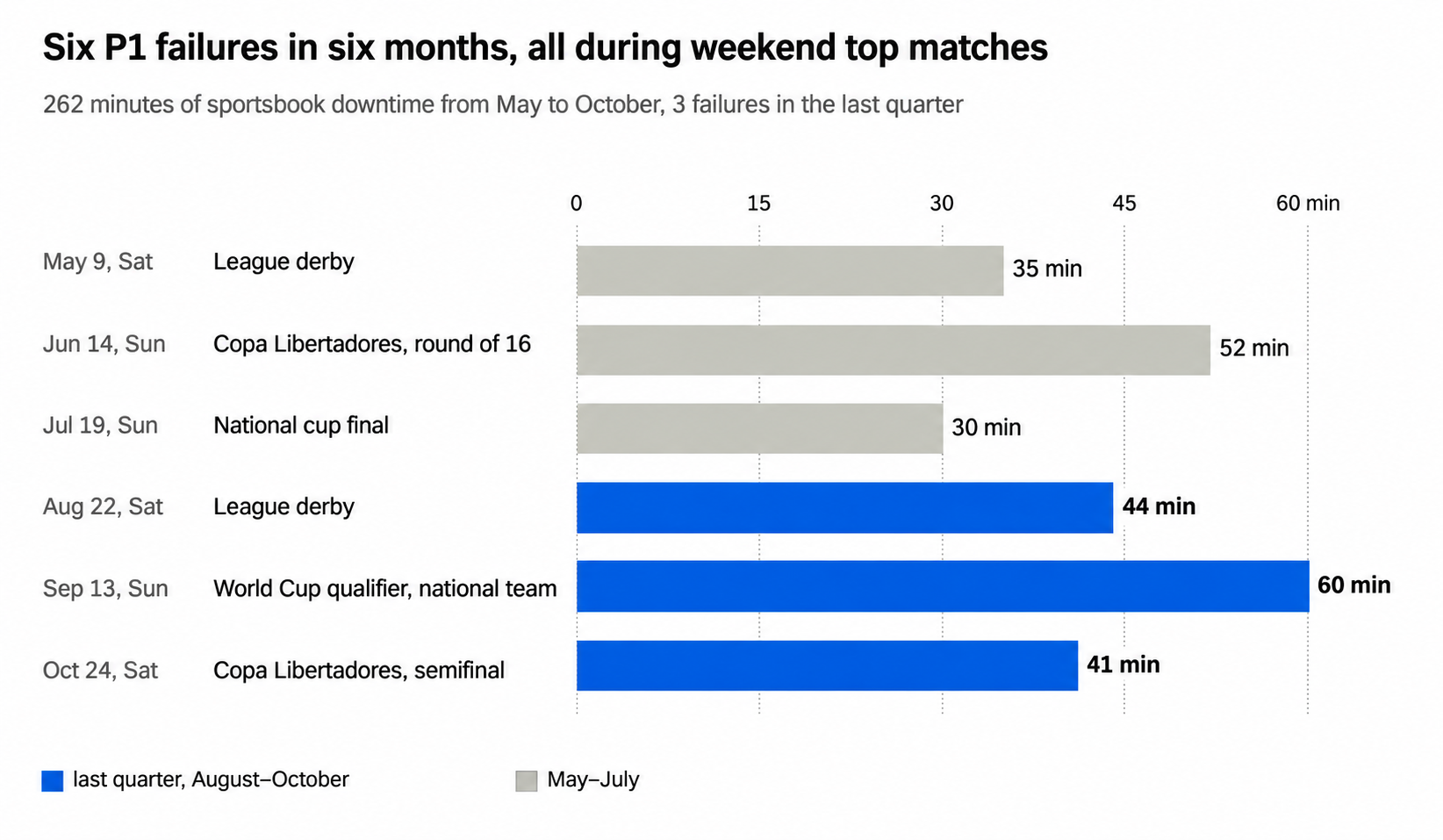
P1 incidents, May–October 2026
Every outage coincided with the match that draws the week’s peak betting, so we calculate the cost of a failure on the peak hour, not on the average one.
The approach: replace one module, keep the rest
- Calculate what staying costs. Don’t compare downtime with migration. Compare the full cost of outages with the full cost of replacement.The threshold is simple. If replacing the sportsbook, including the dual-stack period, costs less than the annual outage losses ($222,600 in this scenario), the migration pays back in the first year even before any growth. If it costs more, we say so honestly.
- Replace only what fails. Only the failing module is updated, whether that is the sportsbook or the casino API. The new module connects to the current wallet through an API, and the rest of the platform stays in place. In this case the sportsbook changes, and the transition risks are closed in advance.
| Risk | How it is closed |
|---|---|
| Open bets hang between two platforms | Switch in a window with no top events. Bets opened on the old platform settle there. Void and cashout rules are agreed in advance |
| Balance mismatch between casino and sportsbook | One wallet as the single source of truth, unique operation IDs, daily reconciliation |
| New platform can't hold the peak | Load test on the profile of a real top match with a 2x margin before the switch |
| Rollback after new bets have been placed | Stop criteria and a decision owner assigned in advance, with a rehearsed procedure for moving new bets back |
| Players can't find familiar markets | Line comparison before launch, player notice 3 days ahead |
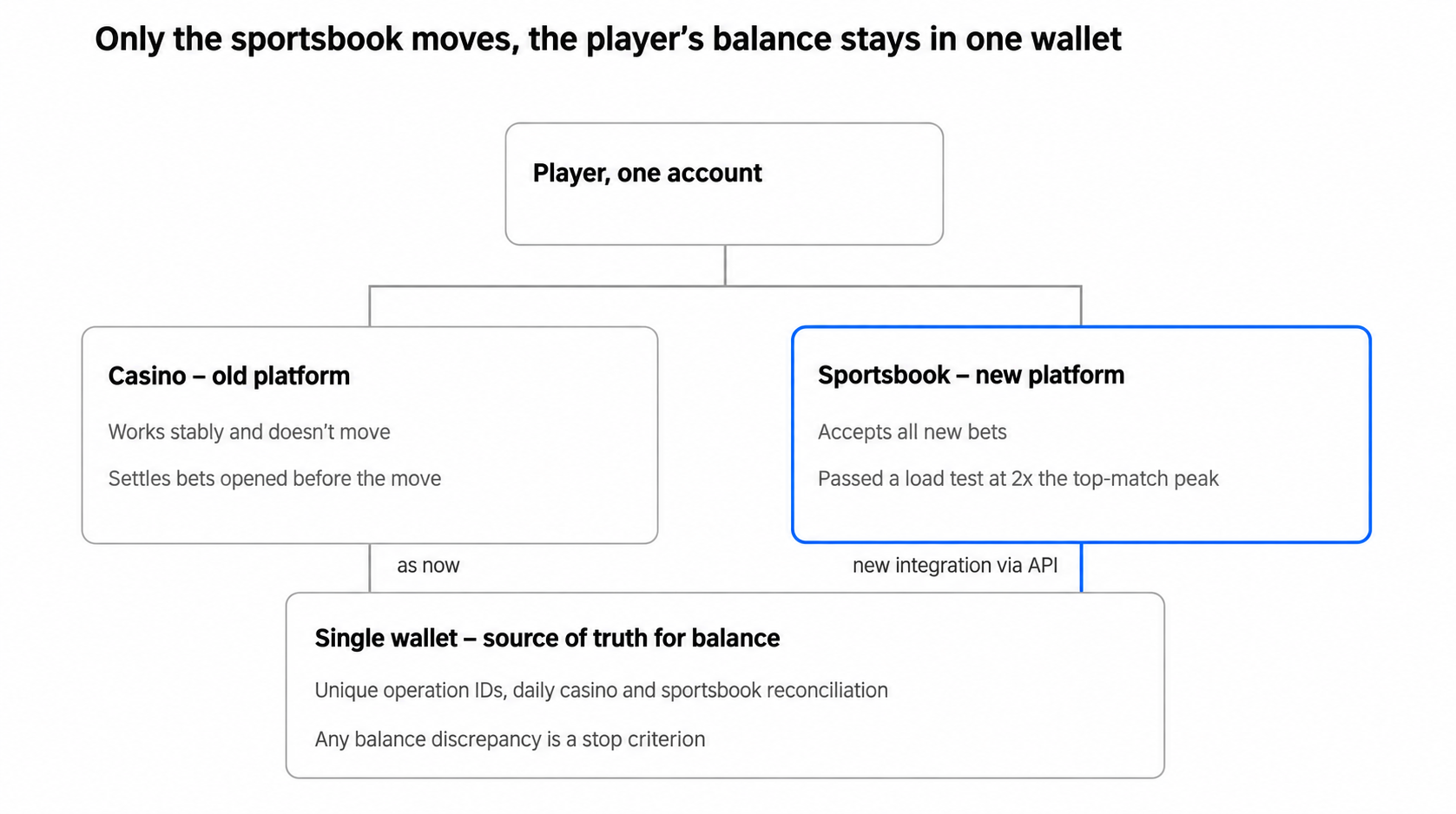
Dual-stack scheme · 2 platforms, 1 wallet
The player doesn’t notice the move. Account and balance stay the same, and only the engine that accepts bets changes.

- Switch in a controlled way, with the right to roll back. The migration goes in six steps.
- Review six months of incidents and the peak-match load profile.
- Integrate the new sportsbook with the current wallet through an API.
- Load test and check void, cashout and settlement.
- Rehearse the switch on a copy of the data.
- Switch in a window with no top events, starting with part of the traffic.
- Provide 72 hours of reinforced support, with the migration engineer watching the first top match.
Before launch we fix the stop criteria and agree the thresholds with the operator.
- Share of rejected bets
- Bet acceptance time
- Any balance discrepancy
The current provider crosses the threshold at an ordinary match peak. The new platform stays within it even at double load, and that is the condition for being cleared to switch.
The current provider crosses the threshold at an ordinary match peak. The new platform stays within it even at double load, and that is the condition for being cleared to switch.
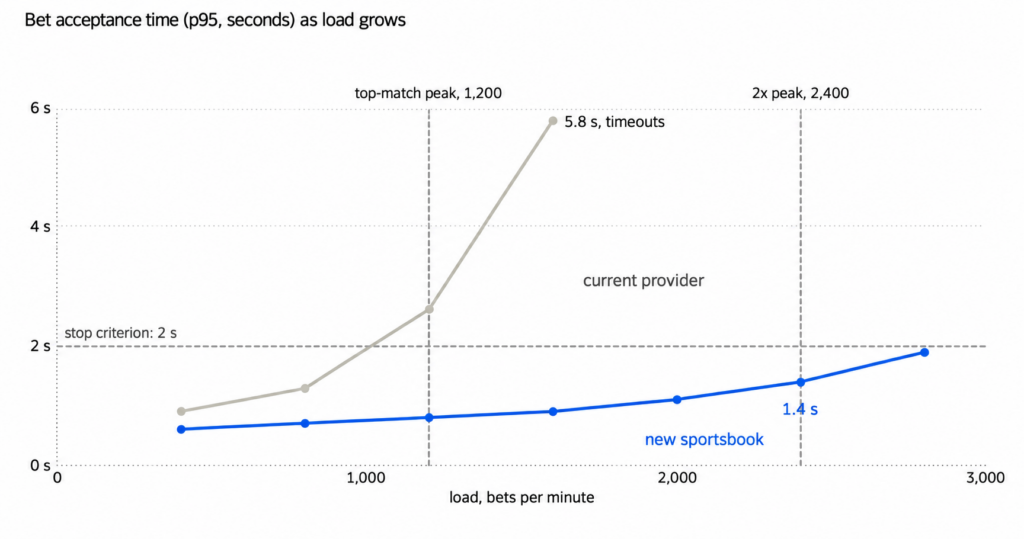

The same logic on the casino side
A casino and sportsbook operator in Brazil with monthly GGR of $240,000 was losing money not on bets but on its game aggregator’s API. On peak Friday and Saturday evenings games failed to launch, spins froze and the balance drifted from the wallet.
The team replaced only the aggregator integration with a new casino API. The platform, the sportsbook and the wallet stayed as they were. The switch went game provider by game provider, starting with 10% of traffic.
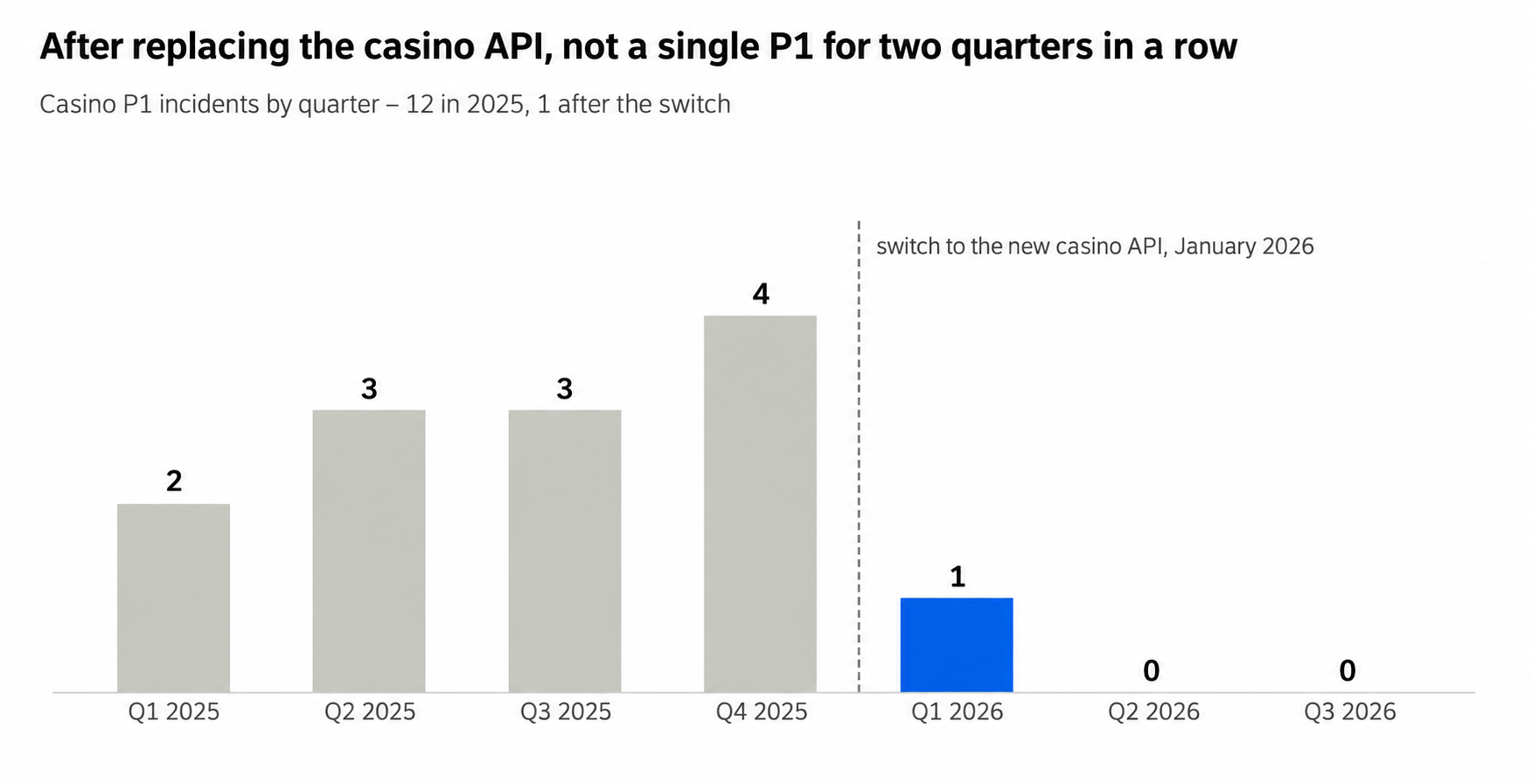
Casino P1 incidents, Q1 2025 – Q3 2026
The other metrics were recorded before the switch and checked again 3 months later.
| Metric | Before the switch | After 3 months |
|---|---|---|
| Game launch time, p95 | 6.2 s | 1.8 s |
| Game launch errors | 4.1% | 0.6% |
| Transaction mismatches in daily reconciliation | 37 per week | 2 per week |
| Casino support tickets | 510 per month | 190 per month |
| Casino player retention, day 30 | 27% | 32% |
The CTO received the following artifacts.
- Load test report
- Integration diagram of the new API with the wallet
- List of stop criteria
- Rehearsal protocol
Main result: the operator removed the casino failures without touching the platform, the sportsbook or the wallet. The decision to replace the module rested on a calculated cost of outages, not on the mood after the latest crash.

What BSW can do for your platform
We help operators update a sportsbook or casino API without replacing the whole platform.
- P1 incident review and cost calculation
- Load testing on a peak-match profile
- Integration of a new sportsbook or casino API with the current wallet
- Transfer of open bets, void and cashout handling
- Stop criteria and a rollback plan



Ready to
launch your business?
An advanced provider of betting software operating globally. A wide range of innovative products and services for both sports and virtual and casino betting.