





What Do Betting Odds Mean?

Odds Definition: Sports Betting Odds Explained
Odds are the price a sportsbook puts on a particular outcome – that single number encodes two things: how likely the event is judged to be, and what a winning bet pays.
The English dictionary lists several different meanings of the word, from general chance to the head start given to a weaker side. In a betting market the definition of odds is tighter. The figure turns a stake into a potential payout and, read backwards, turns that payout into the probability of an event occurring.
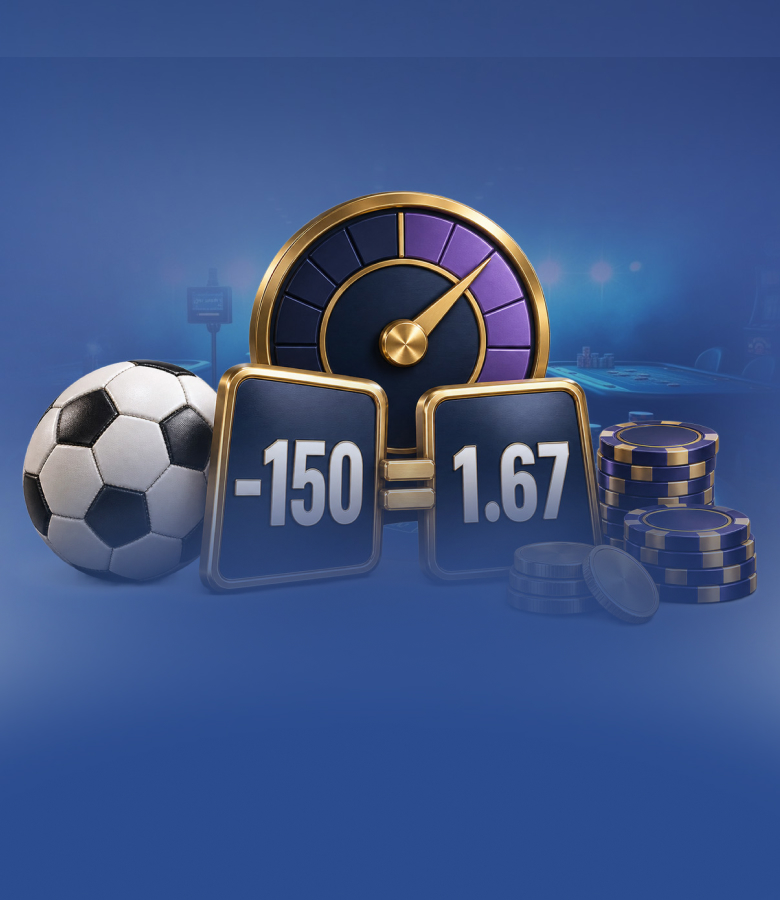
For an operator, the second reading matters most. The meaning of odds is a pricing question, and every format displays the same decision. A bettor looking at -150 for a team to win and a bettor looking at 1.67 are reading one price.

Decimal Odds, Fractional Odds and American Odds
Three formats cover almost every betting market.
- Decimal Odds
Decimal odds show the total return per unit staked. At 4.50, a $10 bet returns $45, stake included.
Continental Europe uses this format almost everywhere, so it is often labeled European odds. The number equals the fractional price restated over a denominator of 1, with the stake added back.
- Fractional Odds
Fractional odds are the traditional odds of British and Irish betting shops and racing. They are expressed as a ratio of profit to stake.
In 7 to 2, written 7/2, the numerator is profit and the denominator is stake – a $10 stake wins $35, and the stake back brings the total return to $45.
- American Odds (Moneyline)
In the American format, called the moneyline, odds for favorites are displayed with a minus sign, while those for underdogs are with a plus sign. In +200 odds, there will be a profit of $200 on an investment of $100, giving a total payoff of $300.
In case of negative odds like -150, the value indicates the amount required for earning $100, which will be $150. The usual Vegas odds for a point spread game are -110 for both sides. An even money, which is the one that pays the exact amount staked on the bet, will be 1/1, 2.00, +100.
| Decimal | Fractional | Moneyline | Implied chance |
|---|---|---|---|
| 1.20 | 1/5 | -500 | 83.3% |
| 1.67 | 4/6 | -150 | 60.0% |
| 2.00 | 1/1 | +100 | 50.0% |
| 4.50 | 7/2 | +350 | 22.2% |
| 101.00 | 100/1 | +10000 | 1.0% |
Converting Odds to Probability and Payout
Converting odds into a chance takes one line of arithmetic per format.
- Decimal: divide 1 by the number, so 4.50 gives 22.2%.
- Fractional: divide the denominator by the sum of both parts, so 7/2 gives 2/9, the same 22.2%.
- Moneyline, positive: 100 / (odds + 100).
- Moneyline, negative: odds / (odds + 100), with the sign ignored.
The output is the implied probability, the price expressed as a chance. A price of 100/1 implies close to a 1 in 100 chance.

Long Odds and Short Odds
Odds with a high probability, like 50/1, have low chances of occurring. If one stakes $10 on an event with odds of 50/1 and wins, the winnings would be $500. In total, the money won would be $510.
In the case of payout, things get reversed. The amount that could be won is written on the slip before one places the bet. This is the stake multiplied by the decimal price. After subtracting the stake, the money left is profit. For instance, if one bets $100 at 3.00 and wins, the winnings would be $300.

Odds Impact: Margin Across Types of Bets
Add the implied probabilities of every outcome in a market and the total exceeds 100%. That excess is the overround, the margin the bookie builds into the price.
A balanced two-way market at -110 on each side implies 52.38% per side and 104.76% in total. The bookmaker’s edge on balanced handle is 4.55%. True odds, priced with no margin, would be 2.00 on both sides.
The same check works at 1.91 on both sides. Each price implies 52.36%, the total is 104.71%, and removing the margin returns 50% per side. Operators run this normalization to read a competitor’s market or to audit their own.
“Behind every bookmaker’s odds quote, there are two hidden numbers”
— Karl Whelan, professor of economics, University College Dublin
Those numbers are the assumed probability of the outcome and the built-in profit margin. Whelan’s research shows they can be separated from the odds alone only when the same margin is applied to every outcome. Real markets rarely meet that condition.

Margin is not flat across types of bets:
- Core markets: the moneyline and the point spread on major leagues are usually priced the tightest.
- Parlay bet: it multiplies the prices of its legs, so the margin on each leg compounds in the final payout.
- Futures betting and prop bets price in wider margins, because the trader has thinner data and less liquidity.
Odds also move as money arrives and as models update. A bettor can make a profit over time only by finding a price where their own probability estimate beats the one in the odds. Sports bettors shop between sportsbooks for exactly that edge.
For operators, margin is a per-market setting inside the engine. BSW’s sportsbook offering includes real-time odds with margin control on every betting action.
FAQ
What is the meaning of the word 'odds' and how is it used in different contexts?
In everyday English, odds describe how likely something is, as in “the odds are against it,” or the advantage given to one side. In gambling, the word names a quoted price that fixes a payout. In statistics, odds are the ratio of the chance an event happens to the chance it does not, which differs from probability.
What do the plus (+) and minus (-) signs mean in betting odds?
A plus figure shows the profit on a $100 stake, so +250 returns $250 in profit. A minus figure shows the stake needed to win $100, so -200 means risking $200. Plus usually flags the underdog and minus the favorite, while +100 and -100 describe the same 50% price.
What are the different types of betting odds, such as American, Fractional, and Decimal?
Decimal shows total return per unit, fractional shows profit against stake, and moneyline shows profit on 100 or the stake needed to win 100. All three quote the same price, so a 2.50 decimal equals 3/2 fractional and +150.
How do betting odds work and how are payouts calculated?
Odds set the price of a wager. Multiply the stake by the decimal price for the total return, then subtract the stake for profit. At 2.50, a $10 stake returns $25 and earns $15. With fractional odds, 3/2 gives the same $15.
What is the meaning of 'long odds' and 'short odds'?
Long prices, such as 50/1, belong to outcomes the market thinks unlikely and pay heavily on a win. Short prices, such as 1/5, mark heavy favorites and pay little. Length describes the price only.
How do odds relate to probability in betting?
Odds are probability with a margin added. Divide 1 by the decimal price to get the implied chance, then total the chances across all outcomes. Anything above 100% is the overround. Dividing each chance by that total gives the market’s estimate of true probability.



Ready to
launch your business?
An advanced provider of betting software operating globally. A wide range of innovative products and services for both sports and virtual and casino betting.